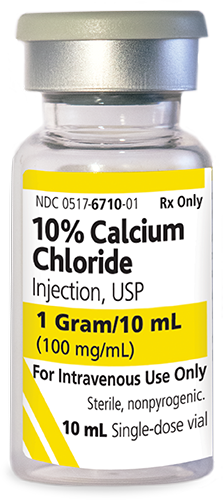
10% Calcium ChlorideInjection, USP
For intravenous use only
A HYPERTONIC SOLUTION IN A 10 ML SINGLE-DOSE VIAL FOR PROMPT INTRAVENOUS INJECTION.
CAUTION: This solution must not be injected intramuscularly or subcutaneously. Administer only by slow injection (not to exceed 1 mL/minute).
- Sterile, nonpyrogenic
- Preservative-free
- Vial closure is not made with natural rubber latex
| Pack NDC# | Strength | Supplied as | Shelf pack | Vial opening size | Product info | Availability | ||
|---|---|---|---|---|---|---|---|---|
|
Strength:
1 Gram/10 mL 10 mL |
0517-6710-10 |
1 Gram/10 mL |
10 mL |
10 | 13 mm | Product Label Full Prescribing Information Safety Data Sheet | In-Stock Shipping Weekly | |
Product Label Full Prescribing Information Safety Data Sheet Wholesaler Numbers
Case Information
|
||||||||
Contact Us
By clicking Submit, you confirm that you accept our Privacy Policy and that you agree to your personal contact information being used to contact you and added to our database. If at any time you wish your personal information to be removed from the American Regent® database, please submit a message request to corpcommunications@americanregent.com.
CONTRAINDICATIONS
10% Calcium Chloride Injection is contraindicated in patients with ventricular fibrillation and patients with asystole and electromechanical dissociation.
Calcium chloride is contraindicated in newborns (up to 28 days of age) if they require (or are expected to require) ceftriaxone intravenous treatment, regardless of whether these products would be received at different times or through separate intravenous lines.
WARNINGS AND PRECAUTIONS
End-Organ Damage Due to Intravascular Ceftriaxone-Calcium Precipitates
The use of Calcium Chloride Injection is contraindicated in newborns (up to 28 days of age) if they require (or are expected to require) ceftriaxone intravenous treatment because of the risk of precipitation of ceftriaxone-calcium, regardless of whether these products would be received at different times or through separate intravenous lines. Cases of fatal reactions with calcium-ceftriaxone precipitates in lungs and kidneys in premature and full-term newborns aged less than 1 month have occurred when ceftriaxone and calcium were administered either simultaneously or non-simultaneously and through different intravenous lines.
In patients older than 28 days of age, Calcium Chloride Injection and ceftriaxone intravenous solutions may be administered sequentially one after another if infusion lines at different sites are used, infusion lines are replaced, or infusion lines are thoroughly flushed between infusions with physiological salt solution to avoid precipitation. Do not mix or administer Calcium Chloride Injection simultaneously with ceftriaxone, even if using different infusion lines or different infusion sites, as it can lead to precipitation of ceftriaxone-calcium.
Hypotension, Bradycardia, Arrhythmias, and Syncope With Rapid Administration
Rapid injection of Calcium Chloride Injection may cause vasodilation, decreased blood pressure, bradycardia, arrhythmias, syncope, and cardiac arrest. It is particularly important to prevent a high concentration of calcium from reaching the heart because of the danger of cardiac syncope. Too rapid an injection exceeding 1 mL/minute may lead to hypotension and cardiac syncope.
Arrhythmias With Concomitant Digoxin Use
Arrhythmias may occur if Calcium Chloride Injection and digoxin are administered together. Avoid the use of Calcium Chloride Injection in patients receiving digoxin.
Tissue Necrosis and Calcinosis
Administration of Calcium Chloride Injection in patients with local trauma may result in calcinosis cutis due to transient increase in local calcium concentration. Administer Calcium Chloride Injection slowly through a small needle into a large vein to minimize the risk of tissue necrosis, ulceration, and calcinosis. Avoid extravasation or accidental injection into perivascular tissues. Immediately discontinue administration should perivascular infiltration occur.
Aluminum Toxicity
Calcium Chloride Injection contains aluminum that may be toxic. Aluminum may reach toxic levels with prolonged parenteral administration if kidney function is impaired. Premature neonates are particularly at risk because their kidneys are immature, and they require large amounts of calcium and phosphate solutions, which contain aluminum.
ADVERSE REACTIONS
Adverse reactions have included paraesthesia (upon rapid injection), calcium taste, sense of oppression, sense of “heat wave,” local burning sensation, injection site extravasation, injection site reactions, peripheral vasodilatation, and decreased blood pressure.
Avoid the concomitant use of Calcium Chloride Injection with digoxin. If concomitant use is unavoidable, monitor ECG closely during administration of Calcium Chloride Injection.
Calcium Channel Blockers
Concomitant use of Calcium Chloride Injection and calcium channel blockers may reduce the response to calcium channel blockers. Avoid concomitant use. If concomitant use is unavoidable, monitor blood pressure closely during administration of Calcium Chloride Injection.
Drugs That Increase the Risk of Hypercalcemia
Increase frequency of monitoring of calcium concentrations in patients taking concomitant Calcium Chloride Injection and other drugs that increase the risk of hypercalcemia (eg, calcipotriene, estrogen, lithium, parathyroid hormone, teriparatide, thiazide diuretics, Vitamin A, and Vitamin D).
USE IN SPECIFIC POPULATIONS
Pregnancy Risk Summary:
There are risks to the mother and the fetus associated with development of hypocalcemia during pregnancy.
Lactation Risk Summary:
There is no information on the effects of Calcium Chloride Injection on the breastfed infant or on milk production. The developmental and health benefits of breastfeeding should be considered along with the mother’s clinical need for Calcium Chloride Injection and any potential adverse effects on the breastfed infant from Calcium Chloride Injection or from the underlying maternal condition.
Pediatric Use:
The safety and effectiveness of Calcium Chloride Injection for the treatment of acute symptomatic hypocalcemia have been established in pediatric patients.
The use of Calcium Chloride Injection is contraindicated in newborns if they require (or are expected to require) ceftriaxone intravenous treatment because of the risk of precipitation of ceftriaxone-calcium, regardless of whether these products would be received at different times or through separate intravenous lines.
Geriatric Use:
In general, dosing for a geriatric patient should be cautious.
Renal Impairment:
The use of Calcium Chloride Injection in patients with renal impairment may increase the risk of a higher calcium-phosphorus product. Monitor serum calcium levels frequently based on the severity of the renal impairment and the risk of a high calcium-phosphorus product.
INDICATIONS AND USAGE
10% Calcium Chloride Injection is a form of calcium indicated for the treatment of adult and pediatric patients with acute symptomatic hypocalcemia.
Limitations of Use:
The safety and effectiveness of Calcium Chloride Injection for long-term use have not been established.
For additional safety information, please see Full Prescribing Information.
You are encouraged to report Adverse Drug Events to American Regent Inc. at 1-800-734-9236 or to the FDA by visiting www.fda.gov/medwatch or calling 1-800-FDA-1088.
REF-0662 03/2024 v4.0