
For intravenous use
- “AB” Rated and therapeutically equivalent to Abraxane®7
- Reimbursed under Abraxane J-code J9264
| Pack NDC# | Strength | Supplied as | Shelf pack | Vial opening size | Product info | Availability | ||
|---|---|---|---|---|---|---|---|---|
|
Strength:
100 mg/vial Supplied As:Single-dose Vial NDC#: 0517-4300-01 |
0517-4300-01 |
100 mg/vial |
Single-dose Vial |
1 | - | Product Label Full Prescribing Information Safety Data Sheet | In-Stock Shipping Weekly | |
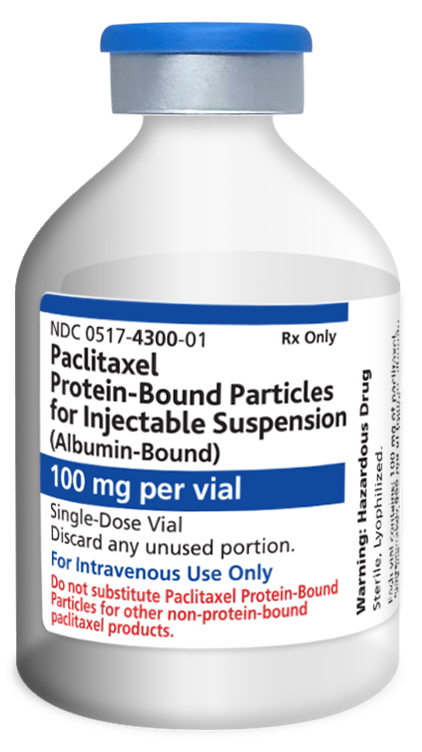
Product Label Full Prescribing Information Safety Data Sheet Wholesaler Numbers
Case Information
|
||||||||
References:
1. Orange book: Approved drug products with therapeutic equivalence evaluations: product details for NDA N211875. US Food & Drug Administration. Accessed December 3, 2025. Paclitaxel Protein-Bound Particles for Injectable Suspension (Albumin-Bound). https://www.accessdata.fda.gov/scripts/cder/ob/results_product.cfm?Appl_Type=N&Appl_No=211875#74
Contact Us
By clicking Submit, you confirm that you accept our Privacy Policy and that you agree to your personal contact information being used to contact you and added to our database. If at any time you wish your personal information to be removed from the American Regent® database, please submit a message request to corpcommunications@americanregent.com.
IMPORTANT SAFETY INFORMATION INCLUDING BOXED WARNING
|
CONTRAINDICATIONS
- Baseline neutrophil counts of <1500 cells/mm3.
- A history of severe hypersensitivity reactions to Paclitaxel Protein-Bound Particles for Injectable Suspension (Albumin-Bound).
WARNINGS AND PRECAUTIONS
Severe Myelosuppression
- Severe myelosuppression (primarily neutropenia) is dose-dependent and a dose-limiting toxicity of Paclitaxel Protein-Bound Particles for Injectable Suspension (Albumin-Bound). In clinical studies, Grade 3-4 neutropenia occurred in 34% of patients with metastatic breast cancer (MBC), 47% of patients with non–small cell lung cancer (NSCLC), and 38% of patients with pancreatic cancer.
- Monitor for severe neutropenia and thrombocytopenia by performing complete blood cell counts frequently, including prior to dosing on Day 1 (for MBC) and Days 1, 8, and 15 (for NSCLC and for pancreatic cancer).
- Do not administer Paclitaxel Protein-Bound Particles for Injectable Suspension (Albumin-Bound) to patients with baseline absolute neutrophil counts (ANC) of less than 1,500 cells/mm3.
- In the case of severe neutropenia (<500 cells/mm3 for 7 days or more) during a course of Paclitaxel Protein-Bound Particles for Injectable Suspension (Albumin-Bound) therapy, reduce the dose of Paclitaxel Protein-Bound Particles for Injectable Suspension (Albumin-Bound) in subsequent courses in patients with either MBC or NSCLC.
- In patients with MBC, resume treatment with every-3-week cycles of Paclitaxel Protein-Bound Particles for Injectable Suspension (Albumin-Bound) after ANC recovers to a level >1500 cells/mm3 and platelets recover to a level >100,000 cells/mm3.
- In patients with NSCLC, resume treatment if recommended at permanently reduced doses for both weekly Paclitaxel Protein-Bound Particles for Injectable Suspension (Albumin-Bound) and every-3-week carboplatin after ANC recovers to at least 1500 cells/mm3 and platelet count of at least 100,000 cells/mm3 on Day 1, or to an ANC of at least 500 cells/mm3 and platelet count of at least 50,000 cells/mm3 on Days 8 or 15 of the cycle.
- In patients with adenocarcinoma of the pancreas, withhold Paclitaxel Protein-Bound Particles for Injectable Suspension (Albumin-Bound) and gemcitabine if the ANC is less than 500 cells/mm3 or platelets are less than 50,000 cells/mm3, and delay initiation of the next cycle if the ANC is less than 1500 cells/mm3 or platelet count is less than 100,000 cells/mm3 on Day 1 of the cycle. Resume treatment with appropriate dose reduction if recommended.
Severe Neuropathy
- Sensory neuropathy is dose- and schedule-dependent.
- If ≥ Grade 3 sensory neuropathy develops, withhold Paclitaxel Protein-Bound Particles for Injectable Suspension (Albumin-Bound) treatment until resolution to Grade 1 or 2 for MBC, or until resolution to ≤ Grade 1 for NSCLC and pancreatic cancer followed by a dose reduction for all subsequent courses of Paclitaxel Protein-Bound Particles for Injectable Suspension (Albumin-Bound).
Sepsis
- Sepsis occurred in 5% of patients with or without neutropenia who received Paclitaxel Protein-Bound Particles for Injectable Suspension (Albumin-Bound) in combination with gemcitabine.
- Biliary obstruction or presence of biliary stent were risk factors for severe or fatal sepsis.
- If a patient becomes febrile (regardless of ANC), initiate treatment with broad-spectrum antibiotics.
- For febrile neutropenia, interrupt Paclitaxel Protein-Bound Particles for Injectable Suspension (Albumin-Bound) and gemcitabine until fever resolves, and if neutropenia, until neutrophils are at least 1500 cells/mm3, then resume treatment at reduced dose levels.
Pneumonitis
- Pneumonitis, including some cases that were fatal, occurred in 4% of patients with the use of protein-bound paclitaxel in combination with gemcitabine.
- Monitor patients for signs and symptoms and interrupt Paclitaxel Protein-Bound Particles for Injectable Suspension (Albumin-Bound) and gemcitabine during evaluation of suspected pneumonitis.
- Permanently discontinue treatment with Paclitaxel Protein-Bound Particles for Injectable Suspension (Albumin-Bound) and gemcitabine upon making a diagnosis of pneumonitis.
Severe Hypersensitivity
- Severe and sometimes fatal hypersensitivity reactions, including anaphylactic reactions have been reported.
- Cross-hypersensitivity between Paclitaxel Protein-Bound Particles for Injectable Suspension (Albumin-Bound) and other taxane products has been reported and may include severe reactions such as anaphylaxis.
- Closely monitor patients with a previous history of hypersensitivity reaction.
- Do not rechallenge patients who experience severe hypersensitivity reaction to Paclitaxel Protein-Bound Particles for Injectable Suspension (Albumin-Bound) with this drug.
Use in Patients with Hepatic Impairment
- Exposure and toxicity of paclitaxel can be increased in patients with hepatic impairment. Closely monitor patients with hepatic impairment for severe myelosuppression.
- Paclitaxel Protein-Bound Particles for Injectable Suspension (Albumin-Bound) is not recommended in patients who have a total bilirubin >5 x ULN or AST >10 x ULN.
- For MBC and NSCLC, the starting dose should be reduced for patients with moderate or severe hepatic impairment.
- For pancreatic adenocarcinoma, Paclitaxel Protein-Bound Particles for Injectable Suspension (Albumin-Bound) is not recommended for patients with moderate to severe hepatic impairment (total bilirubin >1.5 x ULN and AST ≤10 x ULN).
Albumin (Human)
- Paclitaxel Protein-Bound Particles for Injectable Suspension (Albumin-Bound) contains albumin (human), a derivative of human blood, which has a remote risk of viral transmission.
Embryo-Fetal Toxicity
- Based on mechanism of action and findings in animals, Paclitaxel Protein-Bound Particles for Injectable Suspension (Albumin-Bound) can cause fetal harm when administered to a pregnant woman.
- Advise females of reproductive potential of the potential risk to a fetus.
- Advise females of reproductive potential to use effective contraception and avoid becoming pregnant during treatment with Paclitaxel Protein-Bound Particles for Injectable Suspension (Albumin-Bound) and for at least six months after the last dose of Paclitaxel Protein-Bound Particles for Injectable Suspension (Albumin-Bound).
- Advise male patients with female partners of reproductive potential to use effective contraception and avoid fathering a child during treatment with Paclitaxel Protein-Bound Particles for Injectable Suspension (Albumin-Bound) and for at least three months after the last dose of Paclitaxel Protein-Bound Particles for Injectable Suspension (Albumin-Bound).
ADVERSE REACTIONS
Randomized Metastatic Breast Cancer (MBC) Study
- The most common adverse reactions (≥20%) with single-agent use of Paclitaxel Protein-Bound Particles for Injectable Suspension (Albumin-Bound) in the MBC study are alopecia (90%, 94%), neutropenia (all cases 80%, 82%; severe 9%, 22%), sensory neuropathy (any symptoms 71%, 56%; severe 10%, 2%), abnormal ECG (all patients 60%, 52%; patients with normal baseline 35%, 30%), fatigue/asthenia (any 47%, 39%; severe 8%, 3%), myalgia/arthralgia (any 44%, 49%; severe 8%, 4%), AST elevation (any 39%, 32%), alkaline phosphatase elevation (any 36%, 31%), anemia (any 33%, 25%; severe 1%, <1%), nausea (any 30%, 22%; severe 3%, <1%), diarrhea (any 27%, 15%; severe <1%, 1%), and infections (24%, 20%), respectively.
- Sensory neuropathy was the cause of Paclitaxel Protein-Bound Particles for Injectable Suspension (Albumin-Bound) discontinuation in 7/229 patients.
- Other adverse reactions of note with the use of Paclitaxel Protein-Bound Particles for Injectable Suspension. (Albumin-Bound) vs paclitaxel injection included vomiting (any 18%, 10%; severe 4%, 1%), fluid retention (any 10%, 8%; severe 0%, <1%), mucositis (any 7%, 6%; severe <1%, 0%), hepatic dysfunction (elevations in bilirubin 7%, 7%), hypersensitivity reactions (any 4%, 12%; severe 0%, 2%), thrombocytopenia (any 2%, 3%; severe <1%, <1%), neutropenic sepsis (<1%, <1%), and injection site reactions (<1%, 1%), respectively. Dehydration and pyrexia were also reported.
- Renal dysfunction (any 11%, severe 1%) was reported in patients treated with Paclitaxel Protein-Bound Particles for Injectable Suspension (Albumin-Bound) (n=229).
- In all Paclitaxel Protein-Bound Particles for Injectable Suspension (Albumin-Bound)-treated patients (n=366), ocular/visual disturbances were reported (any 13%; severe 1%).
- Severe cardiovascular events possibly related to single-agent Paclitaxel Protein-Bound Particles for Injectable Suspension (Albumin-Bound) occurred in approximately 3% of patients and included cardiac ischemia/infarction, chest pain, cardiac arrest, supraventricular tachycardia, edema, thrombosis, pulmonary thromboembolism, pulmonary emboli, and hypertension.
- Cases of cerebrovascular attacks (strokes) and transient ischemic attacks have been reported.
Non–Small Cell Lung Cancer (NSCLC) Study
- The most common adverse reactions (≥20%) of Paclitaxel Protein-Bound Particles for Injectable Suspension (Albumin-Bound) in combination with carboplatin are anemia, neutropenia, thrombocytopenia, alopecia, peripheral neuropathy, nausea, and fatigue.
- The most common serious adverse reactions of Paclitaxel Protein-Bound Particles for Injectable Suspension (Albumin-Bound) in combination with carboplatin for NSCLC are anemia (4%) and pneumonia (3%).
- The most common adverse reactions resulting in permanent discontinuation of Paclitaxel Protein-Bound Particles for Injectable Suspension (Albumin-Bound) are neutropenia (3%), thrombocytopenia (3%), and peripheral neuropathy (1%).
- The most common adverse reactions resulting in dose reduction of Paclitaxel Protein-Bound Particles for Injectable Suspension (Albumin-Bound) are neutropenia (24%), thrombocytopenia (13%), and anemia (6%).
- The most common adverse reactions leading to withholding or delay in Paclitaxel Protein-Bound Particles for Injectable Suspension (Albumin-Bound) dosing are neutropenia (41%), thrombocytopenia (30%), and anemia (16%).
- The following common (≥10% incidence) adverse reactions were observed at a similar incidence in Paclitaxel Protein-Bound Particles for Injectable Suspension (Albumin-Bound) plus carboplatin–treated and paclitaxel injection plus carboplatin–treated patients: alopecia (56%), nausea (27%), fatigue (25%), decreased appetite (17%), asthenia (16%), constipation (16%), diarrhea (15%), vomiting (12%), dyspnea (12%), and rash (10%); incidence rates are for the Paclitaxel Protein-Bound Particles for Injectable Suspension (Albumin-Bound) plus carboplatin treatment group.
- Adverse reactions with a difference of ≥2%, Grade 3 or higher, with combination use of Paclitaxel Protein-Bound Particles for Injectable Suspension (Albumin-Bound) and carboplatin vs combination use of paclitaxel injection and carboplatin in NSCLC are anemia (28%, 7%), neutropenia (47%, 58%), thrombocytopenia (18%, 9%), and peripheral neuropathy (3%, 12%), respectively.
- Adverse reactions with a difference of ≥5%, Grades 1-4, with combination use of Paclitaxel Protein-Bound Particles for Injectable Suspension (Albumin-Bound) and carboplatin vs combination use of paclitaxel injection and carboplatin in NSCLC are anemia (98%, 91%), thrombocytopenia (68%, 55%), peripheral neuropathy (48%, 64%), edema peripheral (10%, 4%), epistaxis (7%, 2%), arthralgia (13%, 25%), and myalgia (10%, 19%), respectively.
- Neutropenia (all grades) was reported in 85% of patients who received Paclitaxel Protein-Bound Particles for Injectable Suspension (Albumin-Bound) and carboplatin vs 83% of patients who received paclitaxel injection and carboplatin.
Pancreatic Adenocarcinoma Study
- Among the most common (≥20%) adverse reactions in the phase III study, those with a ≥5% higher incidence in the Paclitaxel Protein-Bound Particles for Injectable Suspension (Albumin-Bound)/gemcitabine group compared with the gemcitabine group are neutropenia (73%, 58%), fatigue (59%, 46%), peripheral neuropathy (54%, 13%), nausea (54%, 48%), alopecia (50%, 5%), peripheral edema (46%, 30%), diarrhea (44%, 24%), pyrexia (41%, 28%), vomiting (36%, 28%), decreased appetite (36%, 26%), rash (30%, 11%), and dehydration (21%, 11%).
- Of these most common adverse reactions, those with a ≥2% higher incidence of Grade 3-4 toxicity in the Paclitaxel Protein-Bound Particles for Injectable Suspension (Albumin-Bound)/gemcitabine group compared with the gemcitabine group, respectively, are neutropenia (38%, 27%), fatigue (18%, 9%), peripheral neuropathy (17%, 1%), nausea (6%, 3%), diarrhea (6%, 1%), pyrexia (3%, 1%), vomiting (6%, 4%), decreased appetite (5%, 2%), and dehydration (7%, 2%).
- Thrombocytopenia (all grades) was reported in 74% of patients in the Paclitaxel Protein-Bound Particles for Injectable Suspension (Albumin-Bound)/gemcitabine group vs 70% of patients in the gemcitabine group.
- The most common serious adverse reactions of Paclitaxel Protein-Bound Particles for Injectable Suspension (Albumin-Bound) (with a ≥1% higher incidence) are pyrexia (6%), dehydration (5%), pneumonia (4%), and vomiting (4%).
- The most common adverse reactions resulting in permanent discontinuation of Paclitaxel Protein-Bound Particles for Injectable Suspension (Albumin-Bound) were peripheral neuropathy (8%), fatigue (4%), and thrombocytopenia (2%).
- The most common adverse reactions resulting in dose reduction of Paclitaxel Protein-Bound Particles for Injectable Suspension (Albumin-Bound) are neutropenia (10%) and peripheral neuropathy (6%).
- The most common adverse reactions leading to withholding or delay Paclitaxel Protein-Bound Particles for Injectable Suspension (Albumin-Bound) dosing are neutropenia (16%), thrombocytopenia (12%), fatigue (8%), peripheral neuropathy (15%), anemia (5%), and diarrhea (5%).
- Other selected adverse reactions with a ≥5% higher incidence for all-grade toxicity in the Paclitaxel Protein-Bound Particles for Injectable Suspension (Albumin-Bound)/gemcitabine group compared to the gemcitabine group, respectively, are asthenia (19%, 13%), mucositis (10%, 4%), dysgeusia (16%, 8%), headache (14%, 9%), hypokalemia (12%, 7%), cough (17%, 7%), epistaxis (15%, 3%), urinary tract infection (11%, 5%), pain in extremity (11%, 6%), arthralgia (11%, 3%), myalgia (10%, 4%), and depression (12%, 6%).
- Other selected adverse reactions with a ≥2% higher incidence for Grade 3-4 toxicity in the Paclitaxel Protein-Bound Particles for Injectable Suspension (Albumin-Bound)/gemcitabine group compared to the gemcitabine group are thrombocytopenia (13%, 9%), asthenia (7%, 4%), and hypokalemia (4%, 1%).
Postmarketing Experience
- Hypersensitivity Reactions: Severe and sometimes fatal hypersensitivity reactions. Cross-hypersensitivity between Paclitaxel Protein-Bound Particles for Injectable Suspension (Albumin-Bound) and other taxanes has been reported.
- Cardiovascular: Congestive heart failure, left ventricular dysfunction, and atrioventricular block.
- Respiratory: Pneumonitis, interstitial pneumonia, pulmonary embolism, radiation pneumonitis, lung fibrosis.
- Neurologic: Cranial nerve palsies, vocal cord paresis, autonomic neuropathy resulting in paralytic ileus.
- Vision Disorders: Reduced visual acuity due to cystoid macular edema. Abnormal visual evoked potentials suggest persistent optic nerve damage.
- Hepatic: Hepatic necrosis and hepatic encephalopathy leading to death.
- Gastrointestinal: Intestinal obstruction, intestinal perforation, pancreatitis, ischemic colitis, neutropenic enterocolitis.
- Injection Site Reaction: Extravasation. Severe events such as phlebitis, cellulitis, induration, necrosis, and fibrosis. Recurrence of skin reactions at a site of previous extravasation following administration of paclitaxel injection at a different site.
- Metabolic and Nutritional Disorders: Tumor lysis syndrome.
- Other Clinical Events: Skin reactions including generalized or maculopapular rash, erythema, and pruritus. Photosensitivity reactions, radiation recall phenomenon, scleroderma, and in some patients previously exposed to capecitabine, reports of palmar-plantar erythrodysesthesia. Stevens-Johnson syndrome and toxic epidermal necrolysis. Conjunctivitis, cellulitis, and increased lacrimation.
- Accidental Exposure: Upon inhalation of paclitaxel, dyspnea, chest pain, burning eyes, sore throat, and nausea. Following topical exposure, tingling, burning, and redness.
DRUG INTERACTIONS
- Caution should be exercised when administering Paclitaxel Protein-Bound Particles for Injectable Suspension (Albumin-Bound) concomitantly with medicines known to inhibit or induce either CYP2C8 or CYP3A4.
USE IN SPECIFIC POPULATIONS
Pregnancy
- Based on the mechanism of action and findings in animals, Paclitaxel Protein-Bound Particles for Injectable Suspension (Albumin-Bound) can cause fetal harm when administered to a pregnant woman. Advise females of the potential risk to a fetus and to avoid becoming pregnant while receiving Paclitaxel Protein-Bound Particles for Injectable Suspension (Albumin-Bound).
Lactation
- Paclitaxel and/or its metabolites were excreted into the milk of lactating rats. Nursing must be discontinued when receiving treatment with Paclitaxel Protein-Bound Particles for Injectable Suspension (Albumin-Bound) and for two weeks after the last dose.
Females and Males of Reproductive Potential
- Based on animal studies and mechanism of action, Paclitaxel Protein-Bound Particles for Injectable Suspension (Albumin-Bound) can cause fetal harm when administered to a pregnant woman.
- Verify the pregnancy status of females of reproductive potential prior to starting treatment with Paclitaxel Protein-Bound Particles for Injectable Suspension (Albumin-Bound).
- Advise females of reproductive potential to use effective contraception and avoid becoming pregnant during treatment with, and for at least six months after, the last dose of Paclitaxel Protein-Bound Particles for Injectable Suspension (Albumin-Bound) [see Warnings and Precautions].
- Advise males with female partners of reproductive potential to use effective contraception and avoid fathering a child during treatment with Paclitaxel Protein-Bound Particles for Injectable Suspension (Albumin-Bound), and for at least three months after the last dose of Paclitaxel Protein-Bound Particles for Injectable Suspension (Albumin-Bound) [see Warnings and Precautions].
- Based on findings in animals, Paclitaxel Protein-Bound Particles for Injectable Suspension (Albumin-Bound) may impair fertility in females and males of reproductive potential.
Pediatric
- The safety and effectiveness of Paclitaxel Protein-Bound Particles for Injectable Suspension (Albumin-Bound) in pediatric patients have not been established.
Geriatric
- A higher incidence of epistaxis, diarrhea, dehydration, fatigue, and peripheral edema was found in patients 65 years or older who received Paclitaxel Protein-Bound Particles for Injectable Suspension (Albumin-Bound) for MBC in a pooled analysis of clinical studies.
- Myelosuppression, peripheral neuropathy, and arthralgia were more frequent in patients ≥65 years of age treated with Paclitaxel Protein-Bound Particles for Injectable Suspension (Albumin-Bound) and carboplatin in NSCLC.
- Diarrhea, decreased appetite, dehydration, and epistaxis were more frequent in patients 65 years or older compared with patients younger than 65 years old who received Paclitaxel Protein-Bound Particles for Injectable Suspension (Albumin-Bound) and gemcitabine in adenocarcinoma of the pancreas.
Renal Impairment
- There are insufficient data to permit dosage recommendations in patients with severe renal impairment or end- stage renal disease (estimated creatinine clearance <30 mL/min).
DOSAGE AND ADMINISTRATION
- DO NOT SUBSTITUTE FOR OR WITH OTHER NON-PROTEIN BOUND PACLITAXEL FORMULATIONS.
- Paclitaxel Protein-Bound Particles for Injectable Suspension (Albumin-Bound) has different dosage and administration instructions from other paclitaxel products.
- Dose reductions or discontinuation may be needed based on severe hematologic, neurologic, cutaneous, or gastrointestinal toxicity.
Refer to Full Prescribing Information for complete Dosage and Administration information.
INDICATIONS
- Paclitaxel Protein-Bound Particles for Injectable Suspension (Albumin-Bound) is indicated for the treatment of breast cancer after failure of combination chemotherapy for metastatic disease or relapse within 6 months of adjuvant chemotherapy. Prior therapy should have included an anthracycline unless clinically contraindicated.
- Paclitaxel Protein-Bound Particles for Injectable Suspension (Albumin-Bound) is indicated for the first-line treatment of locally advanced or metastatic non–small cell lung cancer, in combination with carboplatin, in patients who are not candidates for curative surgery or radiation therapy.
- Paclitaxel Protein-Bound Particles for Injectable Suspension (Albumin-Bound) is indicated for the first-line treatment of patients with metastatic adenocarcinoma of the pancreas, in combination with gemcitabine.
For additional Important Safety Information, including BOXED WARNING, please see Full Prescribing Information.
You are encouraged to report Adverse Drug Events (ADEs) to American Regent Inc. at 1.800.734.9236 or to the FDA by visiting www.fda.gov/medwatch or calling 1.800.FDA.1088.
REF-2268 05/2023